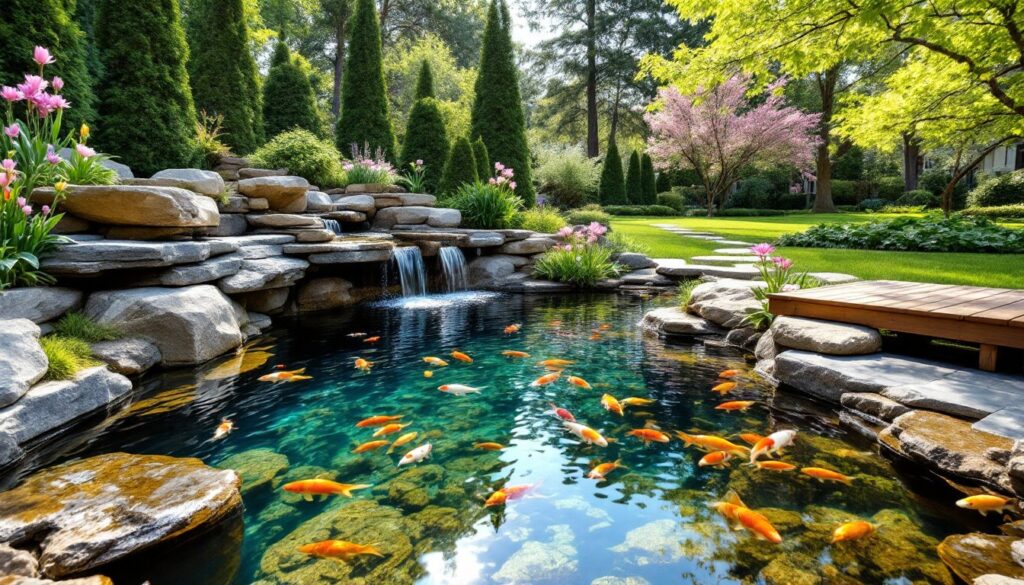

A backyard koi pond brings movement, sound, and living color to an outdoor space. It’s a project that combines landscaping, basic plumbing, and fish husbandry, more involved than planting a garden bed, but well within reach for a prepared DIYer. Whether someone’s working with a corner of a small patio or a sprawling yard, a well-designed koi pond can become the centerpiece of the landscape. This guide covers planning essentials, design styles, budget-friendly builds, and the features that keep koi healthy and the pond looking sharp year-round.
Key Takeaways
- Backyard koi pond ideas transform underutilized yard space into a living focal point that increases property appeal while providing a low-maintenance hobby once the filtration and aeration system is established.
- A minimum koi pond size of 1,000 gallons with at least 3 feet of depth is essential to support fish health, with each full-grown koi requiring 200 to 300 gallons to prevent overcrowding and filtration overload.
- Proper location planning—including proximity to utilities, adequate sunlight (4–6 hours daily), access to water sources, and avoidance of low-lying drainage areas—determines long-term maintenance ease and fish survival.
- Budget-friendly koi pond builds ranging from $1,500 to $3,000 are achievable by using preformed liners, DIY excavation, sourcing local materials, and building simple bog filters instead of commercial alternatives.
- Essential features like skimmers, bottom drains, aeration stones, and waterfalls enhance water quality and visual appeal, while safety measures such as netting and supervision protect fish from predators and reduce household risks.
- Choosing a design style—whether formal, Japanese-inspired, naturalistic, or raised—guides material selection and plant choices, allowing homeowners to balance aesthetics with the ecological balance needed for koi pond success.
Why Add a Koi Pond to Your Backyard?
A koi pond does more than look nice. It increases property appeal, provides a habitat for beneficial wildlife, and offers a low-maintenance hobby once the system is dialed in. Koi are hardy, long-lived fish, some varieties live 25 to 35 years with proper care, and their bright colors (red, orange, white, black, and even metallic blues) create visual interest that shifts with the seasons.
Unlike static water features, a koi pond requires circulation, filtration, and aeration. This keeps water quality stable and supports fish health, but it also means the pond doubles as a naturalistic ecosystem. Frogs, dragonflies, and songbirds often follow. The sound of moving water masks street noise and creates a calming backdrop for patios or decks.
From a practical standpoint, a koi pond adds functional use to underutilized yard space. It can anchor a seating area, replace a high-maintenance lawn section, or serve as a focal point in a larger backyard transformation project. The initial build requires time and material investment, but ongoing care, feeding, seasonal cleanouts, filter maintenance, is manageable for most homeowners.
Essential Planning and Design Considerations
Before digging, map out the pond’s footprint, depth, and proximity to utilities. Contact the local utility locator service (dial 811 in the US) to mark underground lines. Koi ponds typically require a building permit if they exceed a certain depth or volume, check local codes. Some jurisdictions classify ponds over 18 inches deep or 250 gallons as structures requiring inspection.
Pond size directly affects fish capacity and water stability. A minimum of 1,000 gallons is recommended for koi, with at least 3 feet of depth to protect fish from predators and temperature swings. Larger volumes buffer against pH shifts and ammonia spikes. A rough guideline: each full-grown koi needs 200 to 300 gallons. Overcrowding stresses fish and overloads filtration.
Filtration and aeration are non-negotiable. Koi produce significant waste, so a biological filter (housing beneficial bacteria) and a mechanical pre-filter (to catch solids) are standard. A submersible or external pump circulates water through the filter and returns it via a waterfall, stream, or spitter. Pump flow rate should turn over the pond volume at least once per hour: for a 1,500-gallon pond, a 1,500 GPH pump is the baseline.
Sunlight affects algae growth and plant health. Four to six hours of sunlight supports water lilies and marginal plants, which provide shade and help control algae. Full sun all day can lead to excessive algae blooms and temperature spikes in shallow ponds. Partial shade from trees is ideal, but avoid placing the pond directly under deciduous trees, falling leaves increase organic load and clog skimmers.
Choosing the Right Size and Location
Location dictates long-term maintenance and enjoyment. Place the pond where it’s visible from indoor living spaces or outdoor seating areas. Avoid low-lying spots where runoff collects: rainwater carrying fertilizers, pesticides, or sediment can harm fish and destabilize water chemistry.
Slope and drainage matter. A flat or gently sloped site is easier to level and reduces erosion risk. If the yard has significant grade changes, consider a raised or partially above-ground pond using retaining walls or stacked stone. This can cut excavation labor and improve visibility.
Utility access is practical but often overlooked. The pond needs electricity for the pump and, in colder climates, a de-icer or pond heater to maintain a breathing hole in winter ice. Run a dedicated GFCI-protected circuit from the main panel to a weatherproof outlet near the pond. Burying conduit below the frost line (typically 18 to 24 inches in northern regions) protects wiring. If running power is beyond comfort level, hire a licensed electrician, water and electricity require zero compromise on safety.
Proximity to water sources simplifies top-offs and cleanouts. A hose spigot within 50 feet makes seasonal maintenance faster. Municipal water contains chlorine or chloramine, both toxic to fish, so treat new water with a dechlorinator before adding it to the pond.
Popular Koi Pond Design Styles for Every Backyard
Design style sets the tone and influences material choices, plant selection, and hardscape layout. The following styles are widely adaptable and proven to work in a range of climates and yard sizes.
Formal ponds use geometric shapes, rectangles, circles, or ovals, and clean edges. These fit well in modern or contemporary landscapes. Materials include poured concrete, pre-formed fiberglass shells, or EPDM rubber liner with mortared stone coping. Formal ponds often feature symmetrical plantings, raised edges, and minimal surrounding vegetation. They’re easier to clean and maintain than irregular shapes, but concrete work may require a contractor if the builder lacks masonry experience.
Japanese-inspired ponds emphasize natural materials, irregular shapes, and a sense of age and tranquility. Think stacked granite or river rock, wooden bridges, bamboo spouts, and carefully placed boulders. Minimalist koi pond designs often incorporate gravel paths, dwarf conifers, and Japanese maples. Water lilies, lotus, and iris soften edges. This style suits larger yards and benefits from subtle, layered lighting.
Naturalistic or wildlife-friendly ponds mimic the look of a stream or woodland pool. Edges are irregular and planted with native grasses, sedges, and flowering marginals. Boulders and driftwood are placed to look random, not arranged. The goal is to blend the pond into the landscape so it feels discovered rather than installed. Liner edges are buried under soil and mulch, and a bog filter (a gravel-filled plant bed that processes waste) can double as habitat. Many homeowners exploring current outdoor design trends appreciate this style for its low visual impact and ecological value.
Raised or semi-raised ponds use block, brick, or stacked stone walls to elevate the water surface 12 to 24 inches above grade. This makes fish easier to view, reduces bending during maintenance, and can eliminate excavation on sites with hardpan or heavy clay. Raised ponds require solid footings, typically a 4- to 6-inch gravel base topped with a concrete cap, to prevent settling and cracking. This style works especially well on patios or decks (with proper structural support) and in yards with high water tables.
Natural and Wildlife-Friendly Pond Designs
A natural pond design prioritizes ecosystem balance and habitat creation. The approach is less about controlled aesthetics and more about supporting diverse life, beneficial bacteria, insects, amphibians, and native plants alongside the koi.
Edge zones are critical. Instead of a sharp drop-off, a natural pond includes shallow marginal shelves 6 to 12 inches deep planted with hardy rushes, pickerelweed, or arrowhead. These plants filter water, provide spawning habitat, and offer cover for young fish. The pond bottom can include varying depths, a deep zone for koi, shallower basins for plants, and a beach entry if space allows.
Rock and substrate choices affect water chemistry. Avoid limestone or marble, which can raise pH. River rock, granite, and basalt are inert and safe. Some builders skip gravel on the pond bottom entirely to simplify cleaning, while others add a thin layer (1 to 2 inches) to host beneficial bacteria. Both approaches work: it’s a matter of preference and maintenance style.
Plants do heavy lifting in natural ponds. Submerged oxygenators like anacharis and hornwort absorb nutrients that would otherwise feed algae. Floating plants, water lettuce, hyacinth, provide shade and cover. Marginals stabilize edges and filter runoff. A well-planted pond needs less chemical intervention and mechanical filtration, though a skimmer and biofilter are still recommended for koi loads.
These ponds suit homeowners comfortable with a wilder, evolving landscape. They integrate well with broader outdoor makeover strategies that emphasize native plantings and reduced lawn.
Budget-Friendly DIY Koi Pond Ideas
A basic koi pond can be built for $1,500 to $3,000 in materials, assuming the homeowner handles excavation, liner installation, and plumbing. Costs rise with size, complexity, and feature add-ons, but several strategies keep the project accessible.
Use a preformed pond liner for small builds. Rigid polyethylene or fiberglass shells (available in sizes from 100 to 500 gallons) simplify installation, just excavate to match the shape, backfill, and set the pump. These are best for compact spaces and first-time builders. Larger ponds require flexible EPDM rubber liner, sold in rolls or custom sizes. A 10 × 15-foot pond, 3 feet deep needs roughly 250 square feet of liner (calculate with length + 2× depth, width + 2× depth, plus overlap).
Do your own excavation. Renting a compact excavator ($250 to $400 per day) speeds the job if the site is accessible. For smaller ponds, a digging bar, shovel, and wheelbarrow get it done with sweat equity. Haul soil to another part of the yard for berms or raised beds instead of paying for removal.
Source rocks locally. Landscape supply yards sell fieldstone, river rock, and boulders by the ton or pallet, often cheaper than buying bagged stone at a big-box store. A half-ton of mixed river rock covers a typical pond edge. For a natural look, gather stone from the property or nearby (with permission). Avoid treated or painted materials.
Start with a single-chamber biofilter and basic pump. Entry-level pond filter kits ($150 to $300) include a pressurized or gravity-fed biofilter, UV clarifier, and pump. These handle ponds up to 1,500 gallons. Upgrade later if fish load increases. Skip elaborate waterfalls initially, these add pump strain and cost. A simple spitter or return line is adequate.
Plant from divisions or budget sources. Many pond plants spread quickly: ask local pond keepers for divisions of water lilies, iris, or marginals. Native plant sales and online forums are good sources. Avoid expensive specimen koi at first, buy smaller, hardy varieties (4 to 6 inches) to stock the pond while it matures. Simple backyard projects often succeed by starting small and expanding over seasons.
DIY your own bog filter. Instead of a commercial biofilter, build a gravel-filled plant bed at pond level. Water is pumped into the bog, filters through pea gravel and plant roots, then returns to the pond via gravity. A 3 × 6-foot bog handles a 1,000-gallon pond. Line it with EPDM, fill with 3/4-inch pea gravel, and plant with marginals. Total material cost: $200 to $300.
Key Features to Enhance Your Koi Pond
Once the basic pond is functional, features add visual interest, improve water quality, and make ownership more enjoyable.
Waterfalls and streams provide aeration and the soothing sound of moving water. A waterfall requires a pump with adequate head height, the vertical distance from pond surface to the waterfall lip. For a 3-foot lift, a pump rated for at least 2,000 GPH at 3 feet of head is needed (pump output decreases with height). Use flexible PVC or kink-free tubing to route water. Stack rock naturally, avoiding uniform rows, and use pond foam (black expanding foam made for water features) to direct flow and seal gaps.
Lighting extends pond enjoyment into the evening. Submersible LED spotlights (12-volt, low-voltage) highlight fish, waterfalls, or plantings. Install lights on a timer or photocell for automation. Some fixtures are color-changing, but warm white or cool white are most natural. Run low-voltage wire through conduit and connect to a transformer. Never use standard 120-volt lights underwater without proper ratings and GFCI protection.
Bottom drains simplify maintenance in larger ponds. A drain installed at the pond’s deepest point connects to an external filter or settling chamber, pulling debris and waste via gravity. This reduces the need for manual vacuuming. Installation requires plumbing the drain before the liner goes in, not a retrofit-friendly feature, but worth planning for on new builds over 2,000 gallons.
Skimmers skim surface debris, leaves, pollen, insects, before it sinks and decomposes. A mechanical skimmer box sits at the pond edge, drawing water through a net or mat. It’s especially useful in yards with nearby trees. Pair a skimmer with a bottom drain for comprehensive filtration.
Aerators and air stones supplement oxygen, critical during hot weather or when fish loads are high. A dedicated air pump running a diffuser stone keeps dissolved oxygen levels stable, particularly overnight when plants consume oxygen. This is cheap insurance against fish stress and is especially important in ponds with limited surface agitation.
Pond netting protects fish from herons, raccoons, and cats. Stretch 3/4-inch or 1-inch mesh netting over the pond surface, anchored with stakes or landscape staples. It’s not the prettiest addition, but it’s effective and removable. Alternatively, create hiding spots, caves, overhangs, deep zones, that give fish refuge when predators appear.
Plant shelves and pockets integrate vegetation without crowding the pond floor. Build ledges 8 to 12 inches below the waterline during excavation, then place potted marginals or plant directly into gravel-filled pockets. This keeps roots contained and simplifies seasonal trimming. Floating plant baskets work similarly for water lilies and lotus, allowing easy repositioning.
UV clarifiers use ultraviolet light to kill free-floating algae (green water). A UV sterilizer is plumbed inline between the pump and biofilter. Size the unit to the pond volume, an 18-watt UV handles up to 1,800 gallons. Replace the UV bulb annually: output diminishes over time even if the bulb still glows. This feature is optional if the pond has ample plant coverage and good biofiltration, but it’s a quick fix for persistent cloudiness.
Safety note: wear gloves and eye protection when handling pumps, electrical components, and sharp rocks. Keep children and pets supervised around open water, especially during construction. Consider fencing or barriers if the pond will be near play areas. Many successful outdoor renovations balance aesthetics with household safety needs.
A well-planned koi pond becomes a self-sustaining feature that requires seasonal attention but delivers year-round enjoyment. The work upfront, proper sizing, filtration, and smart material choices, pays off in water clarity, fish health, and long-term durability. Whether going for a formal rectangular design or a sprawling natural ecosystem, the fundamentals remain the same: adequate volume, reliable circulation, and a commitment to the basics of aquatic life support.